Manufacturers today are facing pressure from every direction.
Tariffs, reshoring initiatives, supply chain uncertainty, labor constraints, and margin compression dominate executive conversations. Companies are scrutinizing material costs, supplier strategies, freight expenses, and inventory levels in an effort to protect profitability.
Yet one of the most significant sources of cost often remains largely invisible.
It exists inside the quality process.
Not in scrap. Not in rework. Not in customer escapes.
But in the countless manual activities required to move quality information from engineering to manufacturing, suppliers, inspection, and reporting.
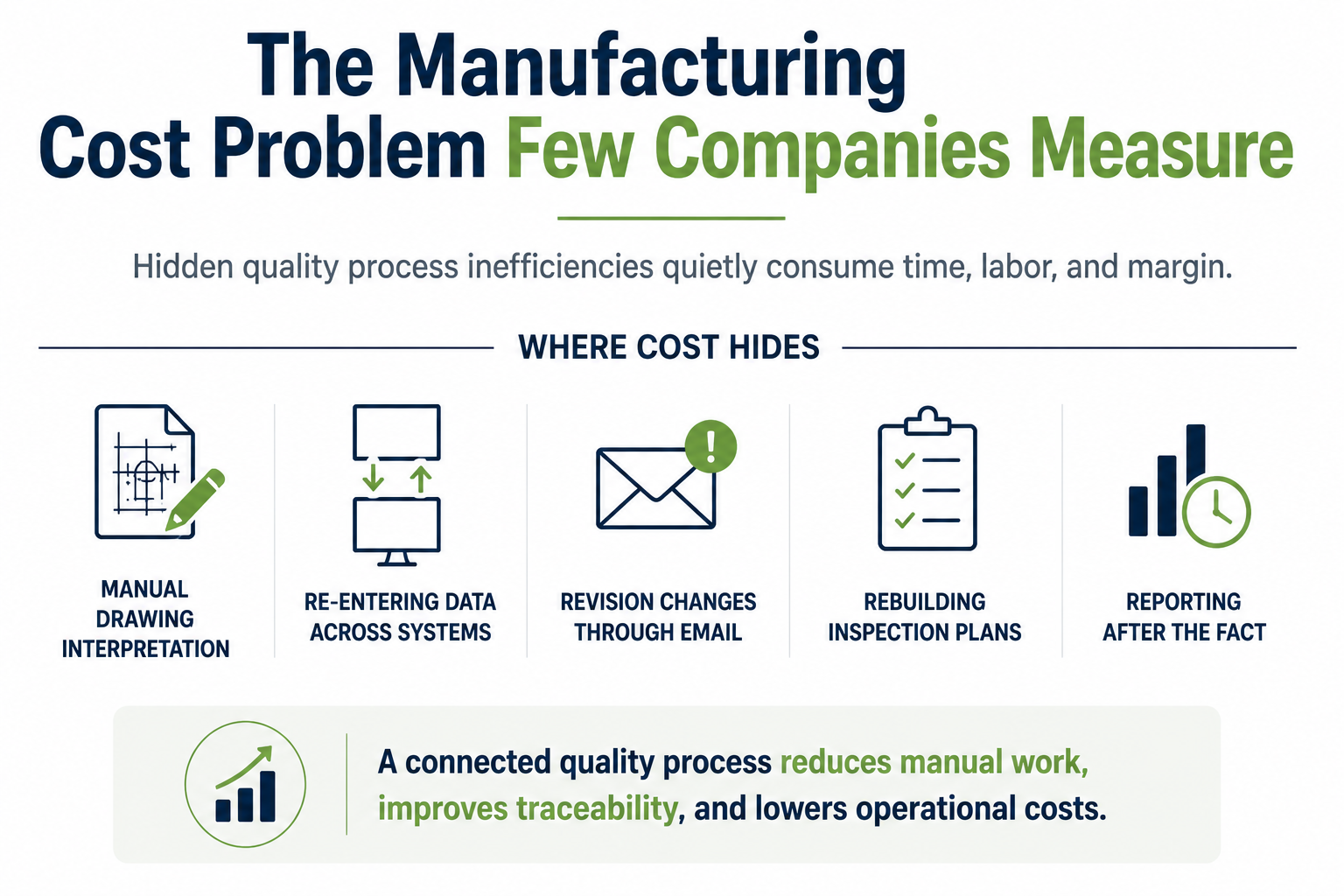
Every time a drawing is interpreted manually, a characteristic is recreated in a spreadsheet, an inspection plan is rebuilt, or a revision change is communicated through email, cost is introduced into the process. Individually these activities seem minor. Collectively, they create operational friction that quietly consumes time, resources, and margin.
As manufacturers navigate tighter trade regulations, increased sourcing complexity, and heightened expectations for traceability and compliance, the tolerance for this friction continues to shrink.
The Hidden Cost Beyond Nonconformance
Most manufacturers understand the financial impact of poor quality.
Scrap, rework, warranty claims, customer returns, and production disruptions are measurable and highly visible.
The larger challenge is quantifying the cost of the work required to prevent those failures in the first place.
Across many organizations, quality processes still depend heavily on manual interpretation and disconnected workflows:
- Engineering requirements are recreated downstream rather than reused.
- Inspection plans are built manually despite existing design data.
- Revision changes require human coordination across multiple systems.
- Supplier quality processes operate independently from internal quality workflows.
- Reports and compliance documentation are assembled after execution instead of being generated from structured data.
These activities rarely trigger alarms. Instead, they manifest as slower execution, increased labor requirements, inconsistent outcomes, and greater opportunities for error.
In today’s manufacturing environment, those inefficiencies have become far more expensive than many organizations realize.
Why Manufacturers Are Rethinking Quality Infrastructure
A noticeable shift is occurring across the manufacturing technology landscape.
The conversation is no longer centered solely on quality documentation or compliance management. Instead, manufacturers are evaluating how quality information moves throughout the enterprise.
Terms such as Digital Thread, Connected Manufacturing, Supplier Quality Management, and End-to-End Traceability have become common because they address a growing business need: reducing the effort required to manage quality while improving visibility and control.
The objective is not simply better reporting.
The objective is eliminating unnecessary work.
When quality requirements flow seamlessly from design into planning, execution, supplier collaboration, nonconformance management, and reporting, organizations spend less time moving information and more time using it.
Why This Matters More Now
Recent developments in North American manufacturing have intensified the urgency.
Ongoing discussions around automotive content requirements, continued tariff pressures on metals and components, and broader supply chain realignments are forcing manufacturers to evaluate every source of cost within their operations.
Historically, organizations have focused first on obvious cost drivers:
- Materials
- Sourcing
- Freight
- Labor
- Inventory
Those areas remain important.
However, many manufacturers are discovering that process inefficiencies embedded within quality operations can have an equally significant impact on profitability.
When engineering changes require manual updates across multiple systems, when supplier quality data exists outside core workflows, or when FAI and PPAP preparation becomes a labor-intensive exercise, the business absorbs costs that are rarely visible on a financial statement but are felt every day by operational teams.
Where Manufacturers Continue to Lose Time
The challenge is rarely a lack of discipline or commitment from quality teams.
More often, the underlying process was never designed to remain connected.
A design change triggers manual updates across departments.
Inspection requirements are recreated despite already existing in engineering data.
Supplier quality information lives in separate systems.
Compliance documentation is rebuilt repeatedly rather than generated from a common source of truth.
Each task appears manageable in isolation.
Together, they create a level of operational drag that becomes increasingly difficult to justify when margins are under pressure and execution speed matters more than ever.
What Better Looks Like
Improving manufacturing quality does not mean adding more software.
It means eliminating unnecessary touchpoints.
It means reducing the number of times quality information must be interpreted, translated, copied, or re-entered.
It means maintaining a direct connection between engineering intent and manufacturing execution.
It means integrating supplier quality into the broader quality ecosystem rather than managing it as a separate process.
Most importantly, it means establishing a continuous digital thread from design through inspection, production, compliance, and reporting.
Organizations that achieve this are not simply improving quality.
They are reducing operational costs, increasing agility, strengthening traceability, and creating resilience against the growing economic pressures facing manufacturers today.
As cost pressures continue to rise, the question is no longer whether manufacturers can afford to modernize quality operations.
The question is whether they can afford not to.