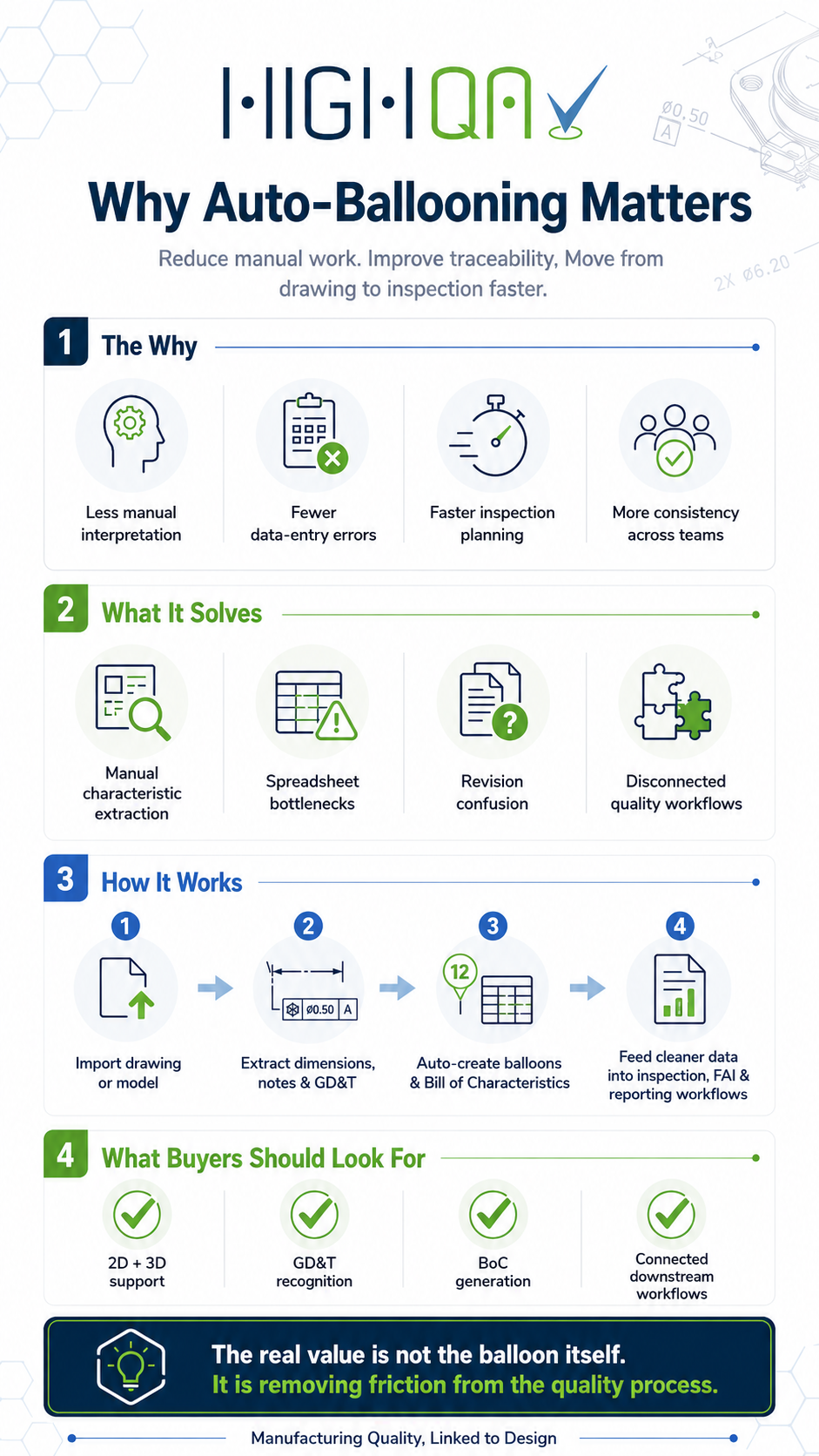
For years, auto-ballooning was viewed as a convenience feature, a way to save time creating ballooned drawings and Bills of Characteristics (BOCs). Today, that view is outdated.
Modern manufacturers are beginning to recognize that auto-ballooning is not simply about faster drawing preparation. It is about eliminating manual interpretation, reducing disconnected workflows, and creating a digital foundation for quality processes that extend far beyond inspection planning.
That distinction matters.
The Hidden Cost of Manual Ballooning
In many manufacturing environments, the quality process still begins manually.
A drawing is opened. Characteristics are identified by hand. Notes are interpreted manually. GD&T requirements are re-entered into spreadsheets or inspection systems. Then someone verifies the work again because the process depends heavily on human translation.
The result is usually two disconnected outputs:
- A ballooned PDF that acts mostly as a visual reference
- A spreadsheet containing manually entered characteristic data
Neither contains true workflow intelligence. The connection between design requirements and downstream quality execution is weak, fragile, and highly dependent on manual effort.
At first glance, this may seem manageable. But the inefficiency does not stay isolated at the ballooning stage. It carries forward into:
- Inspection planning
- First Article Inspection (FAI)
- PPAP preparation
- Shop floor data collection
- Reporting
- Revision management
- Customer compliance documentation
Every manual handoff introduces additional opportunities for inconsistency, delays, and data-entry errors.
Why Manufacturers Are Prioritizing Automation
The growing interest in automated ballooning and GD&T extraction is not driven by aesthetics or convenience. It is driven by operational pressure.
Manufacturers today are expected to:
- Deliver faster
- Support more part revisions
- Handle increasingly complex compliance requirements
- Maintain tighter traceability
- Scale quality operations without scaling overhead
That becomes difficult when quality data must continuously be recreated by hand.
Automated extraction of dimensions, notes, GD&T, and product manufacturing information (PMI) helps remove one of the largest sources of friction inside the quality workflow: manual interpretation.
Instead of rebuilding requirements downstream, quality teams can work from structured digital data captured directly from the source drawing or model.
That changes everything that follows.
The Real Value Is Workflow Continuity
The most important benefit of auto-ballooning is not speed alone. It is continuity.
When quality requirements are digitally captured at the beginning of the process, they can flow more consistently into:
- Inspection planning
- FAIR generation
- PPAP documentation
- Shop floor inspection execution
- Data collection
- Compliance reporting
- Traceability workflows
This reduces the number of times information must be manually touched, interpreted, or recreated.
And that is where manufacturers see measurable impact:
- Fewer data-entry errors
- Improved consistency across teams
- Faster inspection preparation
- Cleaner Bills of Characteristics
- Better revision control
- Reduced risk of customer rejection
- Faster transition from design to production
In other words, auto-ballooning becomes valuable because it improves workflow quality — not simply because it creates balloons faster.
Why “What Happens After the Balloon” Matters Most
As more quality software platforms introduce auto-ballooning capabilities, the feature itself is becoming less of a differentiator.
The more important question is what happens after the balloon is created.
Can the platform generate a usable, structured Bill of Characteristics?
Can it support both 2D drawings and model-based workflows?
Can it intelligently recognize GD&T and PMI?
Can extracted requirements flow directly into inspection planning and reporting?
Can the system reduce manual data handling throughout the entire quality process?
These are the questions that determine whether automation truly improves operations or simply accelerates one isolated step.
Because if teams still need to manually transfer information into spreadsheets, recreate inspection plans, or rebuild requirements downstream, then the workflow remains fragmented.
The value is not in automated ballooning alone.
The value is in eliminating disconnects across the quality lifecycle.
Why This Matters More Than Ever
The pressure on manufacturers continues to increase across aerospace, medical, automotive, defense, and other highly regulated industries.
Quality teams are expected to move faster while supporting stricter compliance requirements, tighter documentation standards, and greater traceability expectations.
Under those conditions, manual setup work becomes increasingly difficult to justify.
What once felt like administrative overhead now directly impacts throughput, scalability, delivery performance, and operational risk.
That is why auto-ballooning has evolved from a tactical feature into a strategic capability.
It is no longer just about creating ballooned drawings.
It is about building a connected quality process that carries design intent forward without forcing teams to recreate quality data at every stage.
Final Takeaway
The real value of auto-ballooning is not the balloon itself.
It is the removal of friction from the manufacturing quality process.
When quality requirements can move digitally from design into inspection, reporting, and compliance workflows, manufacturers reduce manual effort, improve consistency, and create a more scalable operational foundation.
That is why auto-ballooning matters far more today than it did even a few years ago.